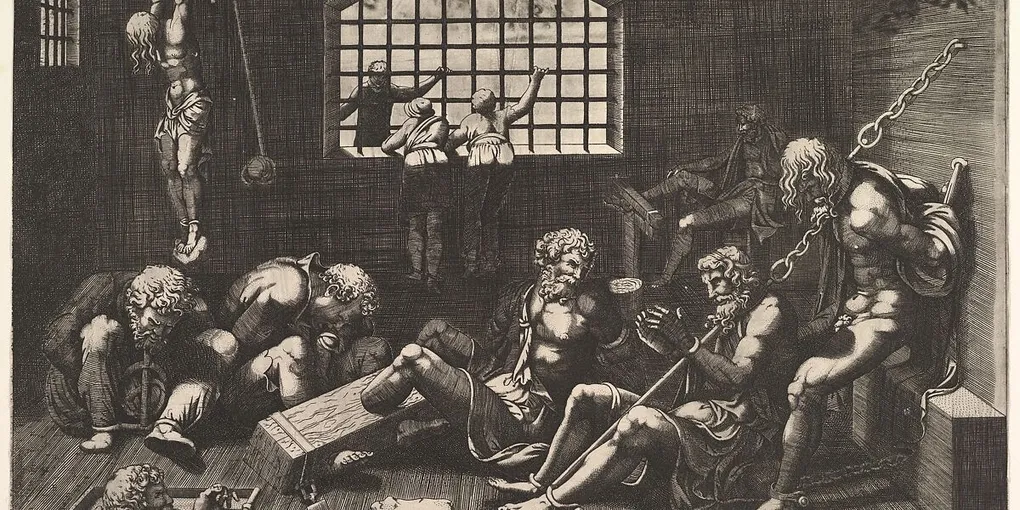
Crime and Rehabilitation Through Suffering
Charles Miller
Suffering makes the average modern American uncomfortable. One could argue that he structures his daily life around avoiding it altogether, seeking instead to maximize comfort and convenience. Life is arranged to be as easy, pleasant, and comfortable as possible, reinforcing societally the belief that suffering is a negative. This mindset has increasingly shaped public conversation about the role and purpose of prisons and how prisoners ought to be treated. A growing view emphasizes therapeutic rehabilitation, with the focus being the swift reentry of the prisoner back into society while minimizing the suffering they must experience. According to this perspective, suffering is purely bad, and just as we should minimize it in our lives, we should also try to reduce it in the lives of criminals. Yet the effort to entirely eliminate suffering from criminal justice is a mistake and misunderstands the distinctive moral role of suffering as shown in Dostoevsky’s Crime and Punishment and Michel Faucult’s Discipline and Punish. Traditionally, suffering is seen not as merely punitive but as a necessary condition for forcing someone to confront their wrongdoing. Through suffering, a criminal is forced to confront their actions, providing a path toward repentance and genuine moral transformation.
Few stories detail the redemptive power of suffering better than Crime and Punishment by Fyodor Dostoevsky, which explores the transformation of the main character, Raskolnikov, after he commits a brutal murder. He partially commits the crime for money but also to test his theory that some extraordinary men can be above moral laws; “I wanted to have the daring … I wanted to find out then and quickly whether I was a louse like everybody else or a man … whether I was a trembling creature or had the right.”1 After committing the crime, Raskolnikov’s world comes crashing down around him as he feels the cosmic weight of the crime he has committed and struggles to live with the guilt that haunts him. When he is back in public after seemingly getting away with the crime, “[h]e felt as if he were nailed to the spot …. A gloomy sensation of agonizing, everlasting solitude and estrangement suddenly rose to consciousness in his soul.”2 Raskolnikov’s punishment, beginning in his own conscience, isolates and traps him in a permanent state of inner torment.
Raskolnikov is miserable and descending into madness; his theory has failed, and he feels he has no way out. But as much as the story is about the fall of Raskolnikov, it is also about his ultimate redemption that comes through his acceptance of his crime and his willingness to suffer for it. He eventually decides to confess to Sonia, the woman he falls in love with, and she encourages him to face the gravity of his crime and confess. She beseeches him, “You must accept suffering and redeem yourself by it.”3 But Raskolnikov is hesitant to accept the terrible thing he has done and face the consequences, “But why am I going there now to give myself up? What for? What have they against me? They have no evidence. It was all a dream… Why should I go? Why confess?”4 Ultimately, he does confess to the authorities and gets sent to prison for eight years of hard labor in Siberia. In confessing, he accepts the suffering required to grapple with the moral consequences of his crimes. As he states toward the end of the novel after spending time in Siberia, “I did not bow down to you, I bowed down to all the suffering of humanity …. It was the suffering that was my teacher. And in it I understood myself, and the meaning of what I had done.”5
As a modern reader, it is easy to assume that what Raskolnikov clearly needed was some form of therapy to reason through his actions. Yet despite his brilliant intellect, and maybe because of his pride in it, he is incapable of simply thinking his way to moral clarity. The novel instead presents suffering as the only necessary path forward, insisting that it is precisely the punishment that Raskolnikov willingly chooses to accept and not shy away from that is ultimately what saves him from madness. The fact that he had the ability to suffer for his crime at the hands of society allows him in some way to bring about justice, to make up for the cosmic imbalance he created by his crime. As he states in the last paragraph of the book, “He had risen again… he knew that he would have to pay for it dearly… but that was the beginning of a new life.”6 But Raskolnikov in some ways represents every criminal who feels they were justified in committing their crime. And in this way, there are many men like Raskolnikov to whom true interior freedom can only come through receiving the justice their crimes demand. Raskolnikov embodies the individual whose very nature demands such justice, revealing suffering as a necessity in moral transformation and repentance. Dostoyevsky is not the only person to identify this link with suffering and redemption. Michel Foucault’s 1975 publication Discipline and Punish provides an interesting historical perspective on the issue of punitive justice. Although in the overall piece Foucault is critiquing the punitive justice system, the story he highlights in the beginning of the book provides a fascinating lens into how older Christian societies viewed suffering in relation to crime. This highly disturbing story tells of a man who is being brutally publicly tortured to death for the regicide of King Louis XV in 1757 France. The question arises: how could Christian men do such a thing to another human being? It is easy to look at the torture and think they simply wanted to hurt the man, but this does not totally align with the story. During his torture, there were priests continually next to him, allowed by the authorities to hear his Confession and offer him the cross of Christ to kiss.7 Why would authorities who hated this man allow him to gain the possibility of eternal life by letting the priests minister to him? Because they thought they were in some way doing good for him. They believed that through his excruciating suffering, he could in some way make up for the effects of the crime he had committed. And even the extreme punishments and torture were understood as a path toward repentance and genuine acknowledgment of guilt.8
This piece is not making the argument that societies should bring back brutal tortures or punishments of the past. I present the case that totally removing suffering from prisons might miss an important aspect of renewal and redemption. The Foucault piece provides a historical perspective on how societies have viewed suffering in relation to crime. It reveals how, in Christian societies less than 300 years ago, societies did not shy away from suffering to create genuine transformations of the heart. Part of this certainly stems from Christianity and the idea that suffering is a gift that must be confronted and accepted for redemption. As Christ said in the Gospel, “If anyone would come after me, let him deny himself and take up his cross daily and follow me.”9 Suffering shapes people into who they are and ultimately, if undergone in the right spirit, makes them better people. Criminals are those who are most in need of transformation and redemption; if suffering is completely removed from the prison system, or the prison system is abolished completely, where will the Raskolnikovs of the world turn to redeem themselves?
To conclude, modern discomfort with suffering has led to a vision of justice that seeks to eliminate it wherever possible. However, both literature and history suggest that this compassionate instinct is fundamentally incomplete. As seen in Crime and Punishment, Raskolnikov is not redeemed through careful examination or psychological intervention, but through the very suffering he tried to resist. In the same way, the perspective presented in Discipline and Punish shows a world where suffering was inseparable from justice and repentance. I do not argue that modern society ought to return to brutal punishments, but I challenge a view that seeks to remove suffering entirely. If suffering is indeed an aid for individuals to confront their wrongdoing and to morally transform, then a criminal justice system that seeks to remove suffering entirely will be missing a fundamental part of human redemption. Justice must be concerned not only with reintegration, but with restoration of the whole individual, and suffering—although difficult and uncomfortable—can help.
N o t e s
- Dostoyevsky, Fyodor, et al. Crime and Punishment. Random House US, 2012. Page 273
- Ibid, pg. 86
- Ibid, pg. 277
- Ibid, pg. 322
- Ibid, pp. 359-360
- Ibid, Epilogue
- Foucault, Michel. Discipline and Punish the Birth of the Prison. Vintage Books, 2011. Page 3
- The Holy Bible. New American Bible Revised Edition, Confraternity of Christian Doctrine, 2011. Heb. 12.6, 11
- Ibid, Luk. 9.23