Disturbed by Joy: Artistry as Divine Translation
The Journal's Arena, Part Two
Zosia Collins
And I have felt
A presence that disturbs me with the joy
Of elevated thoughts; a sense sublime
Of something far more deeply interfused
— William Wordsworth, Tintern Abbey
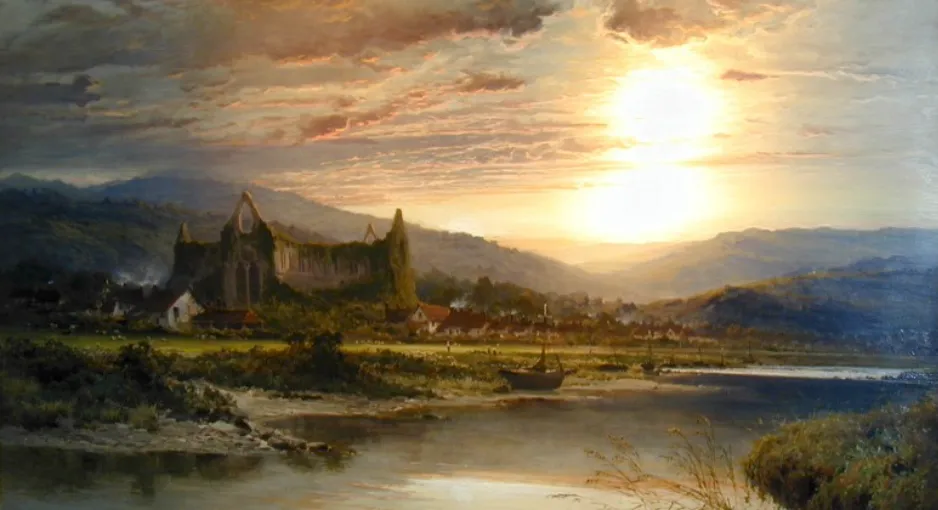
I begin my essay in a similar fashion to Mr. Wilcoxon: by dwelling on a poem. Wordsworth pens the above lines as he is confronted by the breathtaking beauty of the English countryside after escaping the confines of the city; I’ve included the painting “Tintern Abbey” by Benjamin Williams Leader to help us visualize this scene. Wordsworth needs us to know that there is someone or something that he feels he is encountering in this natural scene. This presence disturbs him; it unsettles something inside of him, spurring him to “elevated thoughts” and prompting him to try to capture this presence in the medium of the poem. Mr. Wilcoxon had a similar experience; unsettled by his cousin Charlotte’s sudden burst of poeticism, he was struck by “elevated thoughts” which inspired him to write a delightful essay on artistry. However, I would like to present an opposing view of artistry as a skill evaluated by the quality of a creator’s work— specifically, it is the skill of effectively translating lofty ideals into a more comprehensible medium. I will first elaborate on my definition of art, highlight art’s fundamental connection to artistry, and then proceed to evaluate AI “artistry” through this lens.
Although Mr. Wilcoxon focuses on artistry rather than art, I find it necessary to my argument to first dwell on what art itself is. After discussing the differences between external and internal factors that motivate individuals to create art, Mr. Wilcoxon asserts that artistry is purely a reflection of internal creative factors. I agree with Mr. Wilcoxon’s assumption that art intrinsically represents something about the motivations and experiences of the artist who made it. We can see their creative and aesthetic tastes, and maybe even their own thoughts and feelings towards their subject matter, through the compositions they create. For example, Wordsworth’s poem reveals his deep thoughtfulness and sensitivity toward beauty.
However, although this reflection of the artist is beautiful, it is merely coincidental. The true purpose of Art is not to reflect ourselves, but rather something outside of ourselves. Wordsworth’s goal in writing Tintern Abbey was not to have us understand his awareness of beauty; his goal was to capture some fraction of the beauty itself which set his soul ablaze. Art does not exist to reflect the artist’s internal experiences, although it often does so; it exists so that the artist may attempt to capture the vastness of something external to and high above them. In this sense, art is a process of translation— it aims to convert an infinite mystery into a finite, structured form. Rather than aiming to spark conversations, it seeks to necessitate contemplation.
Now that I have discussed what art itself is, I will return to Mr. Wilcoxon’s original topic of artistry. I have defined art as a process of translation, capturing higher ideals and presenting them in the language of the human experience. As any student of a language (in my case, Latin) will know, you measure your mastery of a language through your ability to produce coherent thoughts in the language. I would consider myself a decently-advanced scholar of the Latin language since I am able to produce a fairly quick and accurate translation of Cicero’s Second Philippic. Quality of results is of vital importance in mastery.
Since art is similarly a process of translation, we should evaluate artistry based on the artist’s grasp of the artistic language, and should do so based on the final translation they produce. Artistry is the objective skill of making truth accessible through beauty. Of course, the bar for being artistic varies with age and ability, as with any skill. If little Timmy, age three, sits and builds small towers out of blocks all day, I might rightfully call him a very skilled builder. I would not, however, say the same of 35-year-old Uncle Billy if he produced the same teetering towers. I would, of course, compliment Uncle Billy on his building skills if he fashioned a large, intricate cathedral out of Timmy’s blocks. We have different standards for the mastery of a skill based on personal capacity. Charlotte—motivated perhaps by wanting to capture the beauty and vastness of the story which suddenly began unfolding in her mind about the Lego colony—translated the beauty she was encountering to the best of her youthful and unformed poetic abilities. She is artistic in the same sense as Wordsworth; both produced poetry that encompassed something higher than themselves at the greatest possible quality. However, being artistic—acting upon one’s full propensity for artistry—is not the same thing as having mastered artistry; this point is reached with the maturity of the artist alongside the honing of their artistic skill, when they are able to craft widely-understood translations of beauty.
Moreover, I would like to emphasize the importance of originality in artistry. If I choose to go online, copy-and-paste a translation of the Second Philippic into a Google Doc, and pass it off as my own, you would not consider me a competent linguist. Similarly, artistry involves bringing a fresh portrayal of an enduring truth rather than just recycling an old one. Now, just for the sake of argument, I’ll point out that this is different from bringing a fresh perspective. A fresh perspective would harken back to Mr. Wilcoxon’s claim that artistry reflects the internal state of the creator. A fresh portrayal, however, can actually be motivated by either external or internal factors. What matters is that the artist has some sort of grasp on eternal truths, so that they can try to represent these truths in their art. It does not matter whether they are inspired or commissioned to do so; as long as they create a product that inspires others to the contemplation of Truth through an experience of Beauty, they are exhibiting artistry to the fullest.
So far, I have argued that artistry is the ability to comprehend something outside of yourself and translate this thing through an artistic medium. This brings us to AI. AI, not being a sentient being, cannot comprehend anything outside itself. Therefore, asking AI to create art is like asking me to translate Cicero’s Second Philippic without giving me the original text. If I were well-studied on my history, I could take a pretty good guess at this gist of it— Mark Antony is a vile human being and an enemy of the republic— and yet I would miss every precisely-chosen word, every subtle turn of phrase which really gives the Philippic its distinct quality. I’d be missing the point of the translation, even while giving a pretty good approximation. AI is the same way. It is incapable of contemplation, of beholding Beauty and confronting the Divine. In this sense, it is incapable of the first step of artistry; it has no access to the original text that you’re trying to translate. Therefore, any image or poem that it creates will be an approximation at best, a hollow shell of anything with real substance. Moreover, it will be drawn solely from the millions of data points that AI has been trained on; there is no true originality in the work. It therefore can never accomplish the true purpose of art, which is inspiring us to contemplation through fresh translation. It has neither the source material nor innovation.
So, Mr. Wilcoxon, I agree that AI is not artistic. However, I cling idealistically to a view of artistry which is fundamentally connected to the quality of art produced; it pertains to translating something outside of the creator rather than expressing something inside of the creator. Art is made to reintroduce us to the Beauty of something above us— as Wordsworth would say, to disturb us with the joy of elevated thoughts. I echo your call to creation, but we must stress the first and essential step in this process to aspiring artists. So I say to them: go encounter something unspeakably lofty, so tantalizingly elusive that it begs you to translate it into a more comprehensible form. Look at the sky, and hold your breath as you marvel at the impossible majesty of light streaming through the brilliant, billowing clouds. Immerse yourselves in the shifting, interwoven sounds of a symphony, and allow yourself to weep with the rawness of the notes. Toil until you form a relationship that slowly reveals what that elusive thing called “Love” is, and then try to catch it and pin it to paper with meticulous letters. Only this intensely human experience of Beauty can raise us to true artistry.