An Apology Owed: How Dostoyevsky Reminds Us That We Need Plato More Than Ever
Zosia Collins
“Discussion”. For most humanities students at UVA, this word evokes an ordeal involving sitting at cramped desks under fluorescent light in awkward silence while the T.A. looks around desperately for someone who is willing to compromise their nonchalance in order to gain a participation point. This scene would surely have shocked Thomas Jefferson, who intended UVA to be a testament to the “illimitable freedom of the human mind”. Yet, in the halls of Mr. Jefferson’s university, our minds are being stifled by an oppressive consensual silence. Fyodor Dostoyevsky’s Crime and Punishment also features a university student, Raskolnikov, although we meet him in the dank streets of St. Petersburg rather than in the classroom. Raskolnikov, too, seems to have forgotten the original meaning of “discussion”; the agitated conversations we hear him having are all with himself. Separated by hundreds of years, UVA undergrads and Raskolnikov find themselves in the same plight; although drenched in intellectualism, they are unable to force themselves into dialogue with others. Why is this a real problem— and moreover, what can we do about it?
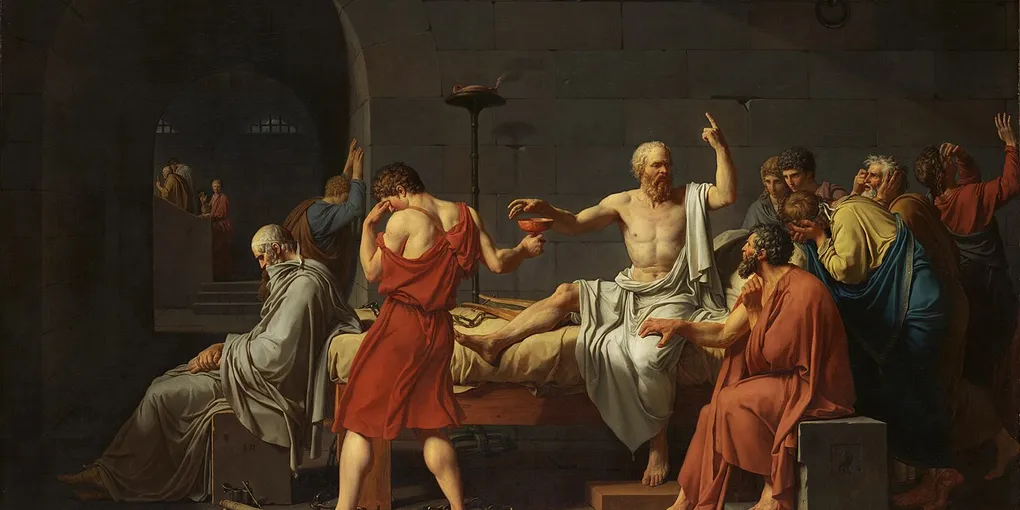
Rather than beginning our search for answers in 21st century Charlottesville or 19th century Russia, I propose an expedition to the dry heat of Athens in the 4th Century B.C. Somewhere in these winding streets, probably locked in a debate with some misguided, pompous young member of the Greek aristocracy, is a balding, ugly old man. Although not part of a university, this man, Socrates, is running a sort of educational institution of his own. One of his students, Plato, is perhaps sitting and taking notes. We can overlook much of what he’s writing, but one term is of vital importance: “philosopher”. Very generally, this word refers to an individual who is able to reach truth by asking themselves and others fundamental questions which challenge the basis of preconceived notions. Through meaningful discussion, the philosopher is able to come to true understanding of issues they investigate. This is the ideal of Western education; this careful, communal examination of reality is the theoretical basis of universities for centuries to come.
With this in mind, let’s leave these Greeks to their riveting discussion and return to the alleys of Russia, where Raskolnikov continues to flounder. Like a typical struggling university student nowadays, he is forced to spend hours alone immersed in intellectual texts; unlike a typical struggling university student, he resolves to murder an innocent pawnbroker who lives nearby. Pondering the truly horrifying and criminal nature of the murder he has resolved to commit, Raskolnikov declares that “it’s better not to think at all!” (Dostoyevsky 71). Through these words, the extent to which Raskolnikov’s education has failed him is apparent. Instead of pondering the reality of his actions in an open and philosophical fashion, he actively shuts himself off from enlightening thought and interior discussion of his crime. Despite his university, which encourages him to isolate himself in order to pore over and produce niche intellectual arguments— or perhaps, because of it— Raskolnikov has lost his will to think. An eerie parallel emerges between him and the college student stubbornly sitting in their discussion doing online shopping and ignoring the T.A’s questions— their silence declares, “it’s better not to think at all!”
It would be one thing if Raskolnikov’s intellectual stagnation was a self-contained vice. However, Dostoyevsky takes this attitude towards a haunting conclusion: it enables Raskolnikov to intellectually amend himself to committing a murder. After bludgeoning the pawnbroker to death, he nearly makes a misstep in his criminal calculations and asks, “what’s the matter with me?” (86). After committing such an egregious crime, it would be fitting for Raskolnikov to pose this question on a serious spiritual level, but he is only able to apply it to a purely worldly consideration. Empty, logistical questioning fills the space which guilt normally would. The moral apathy university has taught him spares him from having to deal with any repercussions of conscience, allowing him to interiorly come to terms with a brutal murder. Stuck in a meaningless discussion with himself, it is clear that the “illimitable freedom” of Raskolnikov’s mind has indeed been wounded to a crippling degree. Raskolnikov’s education has warped him into a “fallen student” — a being driven by powerful intellectualism but lacking the ability to have genuine conversations with himself and others.
While the murderous “fallen student” is a horrifying creation, Dostoyevsky does not stop here; he points out that the morally passive nature of this “fallen student” means that they will continue on their path of destruction unless acted upon by an outside force. This is demonstrated as Raskolnikov talks to the crime’s investigator, Porfiry. Raskolnikov’s empty questions continue as he scrutinizes his latest statement and berates himself for a mere two words: “Why did I insert that ‘I think’ ? … And why does it bother me that I inserted that ‘I think’?” (318). Raskolnikov’s irrelevant and scattered questions conveniently prevent him from even considering the possibility of confessing his crime to Porfiry, repenting, and doing penance. The modern collegiate aversion to real, substantive discussion locks him into his current course of action, allowing the “fallen student” to live at large and prowl about looking for his next victim.
Luckily, one philosopher is dwelling, hidden, in the pages of Crime and Punishment. We meet him in the character of Porfiry as he is confronting Raskolnikov about his crime; he is gently corrective rather than aggressive, asking, “have you really lived so long, though? Do you really know so much?” (437). By casting Raskolnikov’s personal authority and knowledge into doubt, Porfiry equips him with an intellectual humility conducive with questioning presuppositions– even that of his own competence. Porfiry continues in his attempt to dispel the mental haze of passivity which engulfs Raskolnikov by suggesting that confession of his crime and resultant suffering will ground him, but on “what shore? How should I know!” (437). By posing the question of Raskolnikov’s ultimate destination without providing an answer, he leaves a line of discovery open for Raskolnikov to pursue himself. Proceeding into increasingly personal territory, he ventures, “you don’t believe in your theory anymore, do you?” (439). He harnesses Raskolnikov’s growing doubt in the prideful theories which culminated in and justified his crime, thus also casting doubt on the morality of the murder itself. Gently but insistently, Porfiry’s interrogation begins to demand a change of perspective and a casting off of old ideas. In the spirit of Socrates, he crafts thoughtful and provocative questions which equip Raskolnikov with fresh intellectual humility, consideration of life’s bigger significance, and freedom from the burden of his prior mindset. Through Dostoyevsky’s narrative, he slowly takes on the persona of Plato’s philosopher, guiding Raskolnikov towards transcendent truths through meaningful dialogue.
Miraculously, exposure to the philosopher begins to heal the “fallen student”. Porfiry convinces Raskolnikov to turn himself in, physically reconciling him with the truth of his crime, but Raskolnikov has yet to come to a spiritual understanding of his guilt and his need for suffering. However, he begins to make this unification of his actions and intentions as he considers, “what was he after? Mere existence?” (521). Clinging to this heavy question, he heaves himself out of his spiritual lassitude and actively starts to seek out truth and understanding. Just as Porfiry, the philosopher, has shown him, he examines the trajectory of his life and his deeper motivations in a distinctly philosophical manner. Continuing this radical openness to truth, he wonders, “everything had to change now, did it not?” (521). Sensing a disconnect between his refusal to acknowledge his culpability and his lifestyle of repentance, Raskolnikov instinctively understands that embracing a philosophical mindset involves reorienting his whole person, body and soul, towards truth. The exact nature of the truth he must pursue is still hazy, but he thoughtfully considers the Faith of one of his dear friends and asks, “can her beliefs not be mine too?” (522). Not stopping at a mere rejection of his old theories, Raskolnikov’s Socratic mindset allows him to consider and personally confront other ideas, prompting his unprecedented serious consideration of religion. Porfiry, as the philosopher, has managed to do what the entire modern university system could not: he shows Raskolnikov how to formulate questions about himself and the foundations of reality. This invaluable tool frees Raskolnikov from the clutches of intellectual stagnation, allowing him to become the philosopher in his own life.
Crime and Punishment at first appears a cautionary tale: it paints a chilling picture of just how easily the education system’s aversion to discussion can create a devilish “fallen student” who will commit ruthless crimes one after the other. However, Dostoyevsky provides an antidote to this appalling fate. The agency of one man who asks open, probing questions is able to resurrect the intellectually and morally curious streak inside Raskolnikov. The implication for our modern university classrooms is clear. Yes, students aren’t partaking in discussions— but maybe that’s because they’re not being asked the right questions. By veering away from the personal and controversial into the cliche and obvious, our professors are running the risk of creating intellectually stagnant mutants out of an entire generation. We need Socratic figures who will push back on our apathy and force us to think again. It will be uncomfortable. It will be divisive. But ultimately, it will be transformative.